
Apr 13, 2019 | Explanatory Power

On April 8, 2010 prior to heading to bed I went to check e-mail. It was around 11:00 p.m., and I saw a message from my uncle that I had trouble processing: my cousin, Anthony, whom I affectionately called Ants, had died in a motorcycle accident that day, all of 45 years of age. That’s not possible, is it? How could Ants be gone, just like that, forever? I cried. And beat myself up because I’d meant to call him for several months, but hadn’t. Now, I would never ever be able to talk to him again, on this earth, although I know by our very well established faith I shall talk to Anthony again.
Every year on the anniversary of Anthony’s death I text or call my cousin Greg, his brother, to remember Anthony and affirm the value he had in our lives. It’s still hard to believe he’s gone. When I said to Greg how fast the nine years has gone since Anthony left us, he replied, “If this is all there is, why bother?” Exactly! The swift passage of time is of course a cliche, but primarily among those of us who’ve lived four decades or more. For those younger, the words “swift passage” are an abstraction with little or no meaning. For me, it wasn’t until I got north of 40 that this time thing started to get out of hand. I came up with an analogy to convey the creeping, unsettling experience of time’s acceleration.
(more…)
Apr 6, 2019 | Apologetics
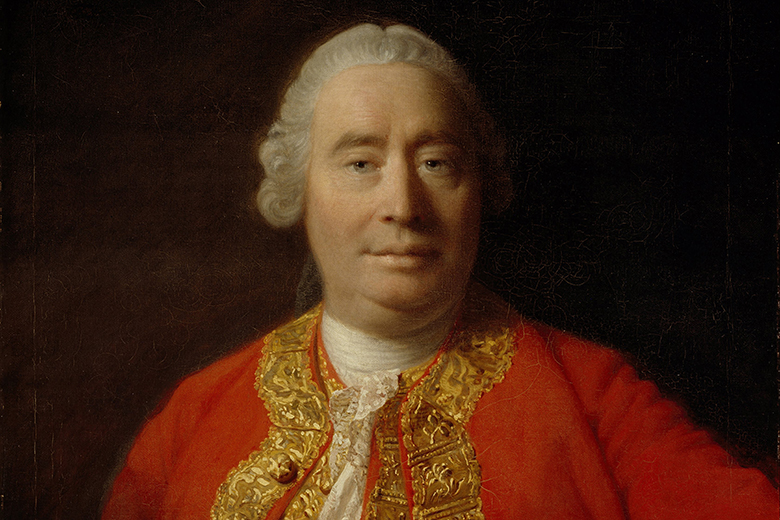
I’ve been slowly reading through Frederick Copleston’s A History of Philosophy, and having recently finished the section on the great Scottish skeptic David Hume, I got to wondering if Hume might come to the same conclusions today. An impossible question to answer, no doubt, like comparing great athletes from different eras, but one worth contemplating. The entire Enlightenment project was birthed in an historical and cultural epoch when a world and universe without God had a certain plausibility to it. Science was a new, exciting phenomenon, and Christian apologetics as a discipline hardly existed. The enterprise to construct a credible explanation of reality based on experience (empiricism) and reason sans God was in its infancy, and a heady enterprise it was. Philosophers, even those who considered themselves Christians, thought they could explain reality without revelation. That hasn’t turned out so well.
(more…)

Apr 1, 2019 | Culture
Probably not, but it should be. If you’re not familiar with the novel, Uncle Tom’s Cabin by Harriett Beecher Stowe (1811-1896), it was published in 1852 to communicate to the American people the evils of slavery. Many people who were not involved in slavery, especially in the north, often had no idea how brutally slaves were treated by their masters. One overview of the book says:
Stowe’s vivid characters and portrayal of their struggles opened reader’s eyes to the realities of slavery and the humanity of enslaved people. Stowe hoped the novel would build empathy for the characters and, in turn, for enslaved individuals.
After seeing Unplanned, there is no doubt that anyone with an open mind and a shred of humanity would be cut to the quick over the realities of abortion, and the humanity of the babies who lives are unceremoniously, coldly, snuffed out.
(more…)

Mar 31, 2019 | Epistemology - Trust
Some years ago I had an Instant Message conversation with a co-worker of mine. It had something to do with religion, and I’ll never forget a phrase she used: “For me, I’ll stick with science.” It was not the forum to challenge such a hollow contention, but it was indicative how many Americans and Westerners think. When we reflect on epistemology, which few people do (unfortunately most Christians as well), the question is how and if we can actually know things. Or in other words, can we have confidence that the things we know are in fact true. In the 21st century secular West the default position is that science is the only reliable way we can know things (scientism). Everything else is guess work or preference, or “true for you, but not for me.” Science can indeed give us wonderful and helpful knowledge, but it is dubious thing upon which to place our trust for true knowledge, and an extremely thin reed upon which to stake all our knowing.
(more…)

Mar 23, 2019 | Explanatory Power
If you’ve ever heard the term “pretzel logic” (not the Steely Dan album), you’ll get the oxymoronic logic: logic shouldn’t look like a pretzel! Those who believe in a God-less universe increasingly have to turn themselves into pretzels to try to explain a universe that sure seems to point to something beyond matter to explain its existence. Thus the multiverse. I thought of the title of the Steely Dan album when I saw this piece in Forbes insisting that the “multiverse” must exist. What exactly is this multiverse, and why must it exist? Well, you can read Mr. Siegel’s argument and see if you agree, but I couldn’t understand about, oh, 90 percent of it. No doubt, that’s a great way to persuade people! I think it’s a lot easier, and more plausible, to say God created the universe, and if there are others, he created those too! (more…)

Recent Comments