
Mar 6, 2017 | Truth

Words mean things . . . This little phrase is one my kids have heard numerous times over the years, probably more than they’d like. And words are among the most profound things about human existence because they allow us to think and communicate.
The profundity of language is built into the nature of the Christian faith. In the first chapter of the first book of our Bible we read, “And God said,” nine times, all in the context of God creating “the heavens and the earth.” Think of the power of one single atom, from which can arise immense forces of destruction. You will maybe then have some sense of the power in the words, “And God said.” He created an entire universe filled with atoms!
(more…)
Feb 28, 2017 | Parents and Family

Since the Enlightenment and the drive by Western cultural elites to make secularism the default plausibility structure of reality, the family has been under attack. It may not have appeared this way to the average mom and dad in the street until the 1960s, but many Western intellectuals have been trying to throw off the shackles (for such is how they see it) of the family for several hundred years. The successful effort to legally redefine marriage is only the latest in this long march. The family is a reflection of the very nature of God, and thus of immense importance; it’s not up for redefinition.
In Genesis 2 when God makes a “suitable helper” for Adam, he established the foundation for the family, but the Triune nature of God is the true basis on which the family exists. The essence of the Triune God is life-giving love, unlike the monism God of other religions. I was reminded anew of the beauty and logic of the Trinity recently as I thought about some who can’t or don’t accept it.
In December of 2015 a professor at Wheaton College, the well known Evangelical college in Illinois, made the claim that Christians and Muslims worship the same God. The two religions venerate the Old Testament, but the Gods they worship couldn’t be more different. I also recently learned about a Christian sect called Apostolic Pentecostalism which rejects the Trinity. For them God is one, end of story. Father, Son, and Holy Spirit are only different revelations of the one God, not three persons in one as understood since the first church Council of Nicea in 325. Mormons and Jehovah’s Witnesses also have the trappings of Christianity, but deny its core. While adherents of these religions think the Trinity is illogical, it actually makes total sense logically. (more…)
Feb 25, 2017 | Culture

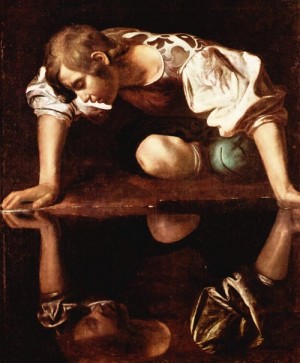
In my previous post I wrote about the word of the year, “post-truth,” and how the triumph of the subjective makes assertions of Christianity as true, or anything as true for that matter (outside of scientific claims), problematic for many of our neighbors. The cultural obsession with the self, reflected in various ism’s (relativism, scientism, skepticism, postmodernism), has lead to people believing that the self is the ultimate authority on everything it surveys. In such a cultural milieu it won’t surprise us that our latest adult generation in the West, those called millennials, are considered the most narcissistic generation ever.
The ancient myth of Narcissus is about a youth who spurned suitors, and then became so taken with the beauty of his image reflected in water that he dies (or kills himself) because he realizes he can never obtain the object of his desire, himself. Though ancient Greek and Roman pagans had no revealed knowledge (i.e., the Bible) of the fallen nature of man, it was clear to many of them that the obsession with the self was endemic to human nature and ultimately self-destructive.
(more…)
Feb 23, 2017 | Truth

In a previous post on the The 4 Horsemen of the Philosophical Apocalypse, I mentioned that Truth in our secular age is a casualty of various ism’s, like , scientism, and relativism. After 50 plus years of Western secular culture watering down Truth with such ism’s, we’ve gotten to the point where they finally get the Word of the Year: Post-Truth. The Oxford Dictionaries decided that we are not much interested in Truth anymore, especially when it relates to shaping public opinion. Their definition of the word:
After much discussion, debate, and research, the Oxford Dictionaries Word of the Year 2016 is post-truth – an adjective defined as ‘relating to or denoting circumstances in which objective facts are less influential in shaping public opinion than appeals to emotion and personal belief’.
(more…)

Feb 21, 2017 | Culture

I saw this title at the Intellectual Takeout website, and was instantly curious. Two of the first three chapters of my book are on truth and epistemology, so I’m a big believer that philosophy is not exactly tangential to keeping our kids Christian. Most Americans, Christians included, think philosophy is only relevant to pointy headed intellectuals, with no bearing on everyday life. These people would be wrong.
Everyone has a philosophy, whether they know it or not, or think through it or not. Most Americans, Christians included, uncritically swallow the philosophical assumptions of our secular culture, and live out their implications in their daily lives. How and what we think about things could not be more profound or practical, which makes the average Christian’s ignorance of these four scary horsemen lamentable. They were originally given this designation by a philosopher of education named Robert Maynard Hutchins in 1951, and they’ve only become more entrenched in the culture since. The brief descriptions from the piece relate to their consequences for education: (more…)



Recent Comments