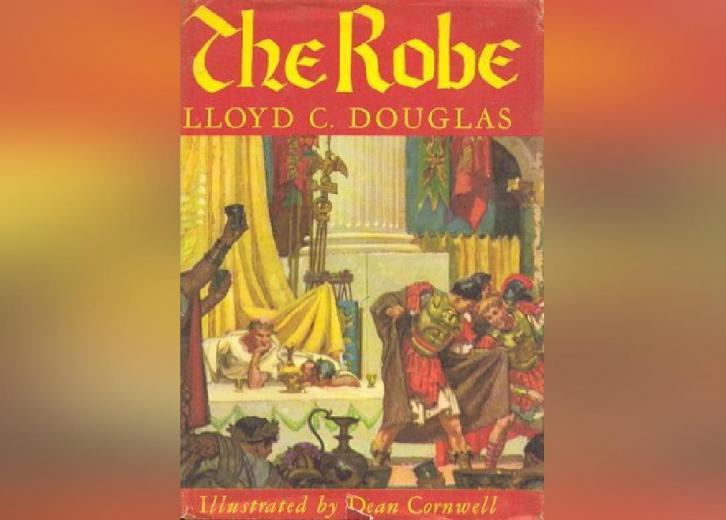
If you’ve never heard of the The Robe (later made into a movie), I’m delighted you are now. The book played an important role in bringing me to Christ. My grandmother gave me a copy when I was 16, and it captivated me. I just finished reading it again for the fifth or sixth time, and I see again why. What captured my imagination all those years ago was the person of Jesus, and his influence on the people who encountered him. He turned them into better people! When I went to college my dorm room was next to a couple “born-again” Christians, and they asked me a question I had to answer yes to because I’d read The Robe: Would you like to see what the Bible says about who Jesus is? Despite being a bit creeped out by these fanatical Bible-thumpers, I couldn’t say no.
In case you are not aware where “Eat the babies” came from, watch this priceless satire of the leftists’ absurd obsession with “climate change”:
The woman was a plant at an AOC townhall, and she appears distraught at the “three months” we have before “climate change” doomsday is upon us. Every time I think of the phrase, “We need to eat the babies,” I laugh, and hearing her voice saying it makes me laugh all the more. The point, so artfully made, and to the oblivious crowd gathered in that room, is that human beings are not the cause of our supposedly impending climate catastrophe. If the “climate change” alarmists are right, then we are, and why not “eat the babies.”
We were all taught growing up that there is this thing called the separation of church and state. The phrase goes back to a letter Thomas Jefferson wrote to the Danbury Baptists (CT) in 1802 where he mentions a wall between the two. This metaphor of Jefferson was transformed by a Supreme Court case in 1947, Everson v. Board of Education, into a partition not between church and state, but between religion and public life that made the Berlin Wall look like rice paper. Ever since, American secular cultural elites have pushed Christianity ever deeper into the crevices of personal experience, so that any expression of specifically Christian faith is deemed, in an appropriate German word, verboten.
Then you don’t know the power of the gospel. I’m going to just quote directly from John Stonestreet and David Carlson at Breakpoint who briefly explain this powerful cultural moment:
News outlets and social media feeds exploded this week with video of one of the most beautiful, powerful, and moving testimonies to the love of God that you’ll ever see.
In a Dallas courtroom, Brandt Jean is addressing Amber Guyger, a former police officer just sentenced to 10 years in prison for killing Brandt’s brother, Botham.
As he chokes back tears, Brandt offers Guyger forgiveness, “I don’t even want you to go to jail,” he says. “I want the best for you, because that’s exactly what Botham would want you to do. And the best would be give your life to Christ.”
Then, he asked Judge Tammy Kemp, “Can I give her a hug please?” Brandt and Guyger embraced.
And if that weren’t enough, Judge Kemp hugged the Jean family, went to her chambers and returned with her personal Bible, which she gave Guyger, and urged her to read it. Then Judge Kemp hugged Guyger.
Glory to God.
Indeed!
Please pray for this young woman, that God’s word given to her by Judge Kemp would transform her from the inside out by God’s Holy Spirit.
Nobody likes a bully. I had my fair share growing up, and would much prefer life without them. The problem is that there can be no life without bullies because we live in a fallen world in a fallen body among fallen, sinful people. On this side of eternity, there will always bullies. Unfortunately, we live in a very strange age where a certain segment of the population thinks life can be cleansed of its unpleasantness, often through some government program or other. There is even government program to stop bullying! So I learned from a piece at Intellectual Takeout with a decidedly different take on bullying: “We Need Bullies so We Can Be Heroes.” That got me to click, because as my kids will tell you, I’m big on the whole life is hard thing, of which I never get tired of reminding them. The piece speaks to the schizophrenic nature of our culture:
Culturally, we understand the role of adversity in growth. Adversity is like Miracle Gro for character. Adversity forms the plots of our most popular films, books, and TV shows. But as our culture works to stamp out “toxic masculinity,” it is also attempting to stamp out human nature itself. Both attempts are doomed to fail at accomplishing their stated goals, but they are likely to do unpredictable damage. If we are able somehow to eliminate bullying, how do we replace an often necessary rite of passage from weakness to strength?




Recent Comments